
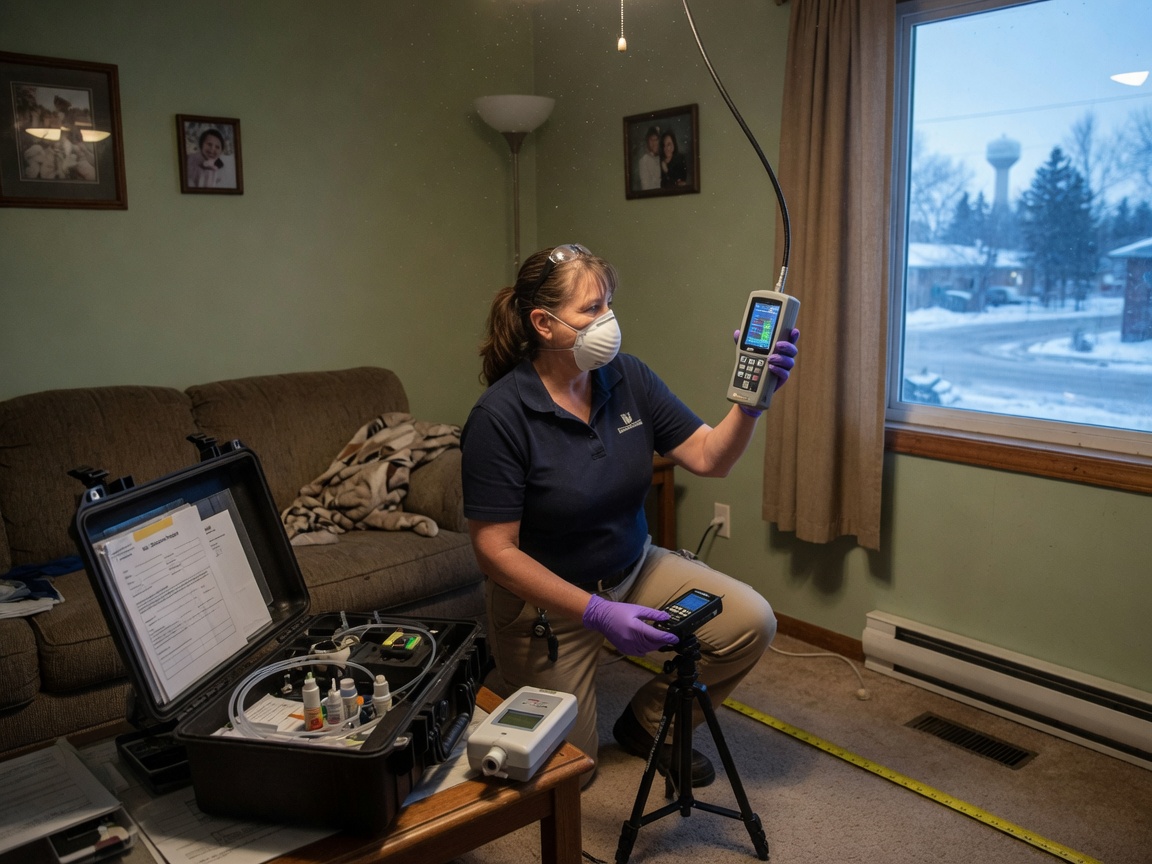
Dickinson's semi-arid continental climate drives long heating seasons that keep homes tightly sealed against cold Stark County winds. This traps combustion byproducts from older furnaces common in Downtown Dickinson and South Dickinson neighborhoods. Testing focuses on particulates and gases that accumulate when fresh air exchange drops during subzero stretches.
Housing stock near Dickinson State University and Patterson Lake often dates to mid-century builds with limited ventilation upgrades. These properties show higher readings for settled dust and moisture-related growth when snowmelt interacts with concrete foundations. Technicians sample at multiple heights and near return ducts to capture how forced-air systems redistribute contaminants across levels.
Portable monitors detect spikes in carbon monoxide near gas appliances during peak winter use when residents run equipment longer. Reports include placement recommendations for detectors and filter upgrades that match the county's wind-driven pressure changes. Homeowners receive guidance on balancing energy efficiency with air exchange without creating drafts in older window frames.
Technician insight
In Dickinson the thing that catches most people out with indoor air quality testing is how long heating seasons keep homes buttoned up so tightly that furnace byproducts never clear, especially in the older stock around Downtown Dickinson where ductwork runs through unconditioned attics that pull in cold air leaks all winter.
South Dickinson Home With Recurring Headaches
Residents noticed headaches during extended cold periods. Testing near the furnace return showed elevated carbon monoxide from a cracked heat exchanger that only surfaced when the system ran continuously against Stark County winds. Replacement and ventilation adjustments cleared the readings and resolved symptoms.
Indoor Air Quality Testing Services We Offer
✓Mold Spore Sampling
Air and surface sampling identifies hidden mold colonies amplified by snowmelt around Patterson Lake foundations and in South Dickinson basements.
✓Carbon Monoxide Level Testing
Continuous monitoring near furnaces and water heaters detects leaks that increase when homes stay sealed during Dickinson's extended cold snaps.
✓VOC and Chemical Screening
Detects off-gassing from household products that concentrate in tightly insulated Downtown Dickinson residences during winter.
✓Dust and Allergen Analysis
Measures fine particulates from semi-arid soils that enter through cracks and circulate via forced-air systems in Stark County homes.
✓Humidity and Moisture Assessment
Evaluates indoor humidity swings caused by heating cycles and spring thaw around Patterson Lake that promote condensation in wall cavities.
Indoor Air Quality Testing Cost in Dickinson, ND
| Service | Typical Range | What Affects It |
|---|---|---|
| Basic IAQ Panel | $250–$400 | Three sample locations plus standard lab turnaround |
| Comprehensive Panel | $450–$650 | Six locations including mold, VOCs, and particulates |
| Carbon Monoxide Spot Check | $125–$200 | Single visit focused on combustion appliances |
| Follow-Up Testing | $150–$275 | After remediation or filter changes |
Ranges are typical for Dickinson, ND and confirmed with an exact written quote before any work starts.
How it works
- 1
Site Walkthrough
Technician inspects furnace location, duct layout, and windows in the specific Dickinson neighborhood to note sealing practices and potential pollutant sources.
- 2
Multi-Point Sampling
Air samples collected from living areas, near returns, and in basements capture how cold-weather operation moves contaminants through the home.
- 3
Laboratory Analysis
Samples sent for identification of mold, particulates, and gases with results compared against regional winter baseline data for Stark County.
- 4
Findings Review
Detailed report delivered with prioritized recommendations that account for local heating demands and older housing construction.
Pricing
Pricing depends on number of samples, home size, and whether rush lab processing is needed.